
Silver Hits Record $59 as COMEX Stocks Drain
Disclaimer: This article reports publicly available market data for educational purposes only. It does not constitute financial, investment, legal, or tax advice. Past performance does not predict future results. Consult qualified professionals and conduct your own research before making decisions. Markets are volatile.
By Doug Young – 07 December 2025
Introduction
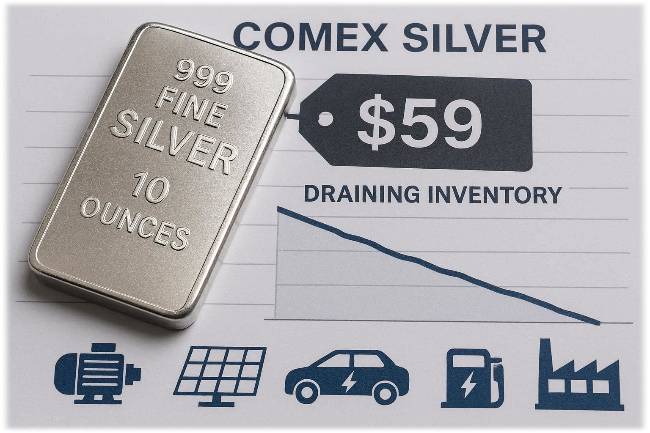
Silver prices struck a record high of $59.32 per ounce on December 5, 2025, amid reports of draining inventories at the COMEX exchange, the primary U.S. futures marketplace for the metal.
This surge reflects a year-to-date increase of approximately 88-98%, fueled by robust industrial demand and tightening physical supplies.
This article presents factual market data from public sources for educational purposes only and does not constitute investment, financial, legal, or tax advice.
Current Market Snapshot
Price Performance
Silver reached its all-time high of $59.32 on December 5, before settling at $58.28-$58.59 later that day, marking a 2% daily gain and a 21% rise over the prior month.
The metal has climbed 88% from the same period last year, surpassing its previous peak of $49.95 from January 1980 after 45 years.
In India, local prices hovered around ₹190 per gram, equivalent to roughly $36 per ounce, influenced by regional premiums and currency factors.
COMEX Inventory Status
COMEX registered silver—available for futures delivery—stood at about 113 million ounces as of late November 2025, with early December reports indicating over 60% of it claimed through deliveries.
Eligible silver, stored but not immediately deliverable, dwarfs registered stocks, contributing to historically low registered ratios, such as 11.1% observed in prior tight markets.
High delivery volumes in December have prompted expectations of inventory restocking by the exchange.
JPMorgan’s Role in COMEX
Reported Holdings
Industry sources report JPMorgan holds around 169 million ounces in COMEX vaults, potentially 40% of total inventories, as part of accumulation estimated at 675 million ounces since 2011.
In June 2025, the bank moved 7.7 million ounces into registered categories, per market observers. These figures stem from public COMEX data and analyst estimates following JPMorgan’s 2008 acquisition of Bear Stearns and a 2010 settlement over manipulation allegations.
Implications for Market
JPMorgan reclassified 134 million ounces from registered to eligible status amid peak demand, reducing deliverable supply.
While unconfirmed by the bank, such moves highlight concentration risks in exchange inventories, tracked via daily CME Group reports. Market participants monitor these shifts for signs of liquidity strain.
Supply and Demand Dynamics
Industrial Demand Drivers
Industrial use accounts for 59% of silver consumption, driven by solar panels, electric vehicles (requiring three times more silver than conventional cars), 5G networks, AI data centers, and medical devices.
The Silver Institute noted record industrial demand in 2024, marking the fourth straight year of peaks, with 2025 forecasts showing continued growth amid green energy transitions. Solar alone consumed significant volumes for conductive coatings.
Supply Constraints
Global mine production has declined 7% since 2016, largely as a byproduct of other metals like copper and zinc, limiting rapid expansion.
The market faced a structural deficit for seven years through 2024, projected at 117-206 million ounces in 2025—its fifth consecutive year—though some analyses predict a 21% narrowing due to modestly higher supply.
Above-ground stocks and recycling fill gaps, but inventories continue depleting.
Recent Market Stress Signals
Exchange Disruptions
A November 28, 2025, COMEX outage lasting over 10 hours due to a data center cooling issue caused silver to spike to $56.72 per ounce, with widened bid-ask spreads signaling illiquidity.
Trading resumed amid heightened volatility, underscoring infrastructure vulnerabilities in derivatives markets.
Paper vs. Physical Gap
COMEX open interest reportedly reached 244% of vaulted silver, illustrating leverage between paper contracts and physical metal.
Silver lease rates peaked at 30% annualized in October before easing, while dealer premiums rose; during the 2020 COVID disruptions, physical coins traded at 60% over spot.
Historical Parallels
Hunt Brothers 1980
In 1979-1980, brothers Nelson and William Hunt amassed 200 million ounces, driving silver to $49.45 per ounce—inflation-adjusted to about $170 today—prompting COMEX rule changes like position limits to halt the squeeze.
2008 Crisis
Paper asset failures shifted demand to physical metals; gold rose 167% from $720 to $1,923 between late 2008 and 2011. Central bank interventions followed, expanding balance sheets significantly.
Lessons for Today
Analysts identify patterns: post-1980 “setup” via paper markets, post-2008 “expansion” through money creation, and current “break” phase with inventory stress.
These events demonstrate how mismatches between derivatives and physical supply can amplify volatility.
Upcoming Catalysts
Fed Meeting December 9-10
Probabilities of a Federal Reserve rate cut stand at 85-87%, potentially weakening the dollar and supporting precious metals prices historically. Chair Jerome Powell’s remarks have previously influenced rallies.
Watchlist Metrics
Key indicators include registered inventories falling below 50 million ounces and gold-silver ratio compression from 72:1 toward historical 15:1 averages.
ETF inflows and lease rates also warrant observation.
Broader Context and Data Sources
Data draws from CME Group filings, Trading Economics charts, Silver Institute forecasts, and reports by Reuters and Investing News Network.
Silver’s 2025 rally aligns with its U.S. Critical Minerals List status and global electrification trends.
Markets remain volatile; verify latest figures independently through official channels, as conditions evolve rapidly.
Disclaimer: This article reports publicly available market data for educational purposes only. It does not constitute financial, investment, legal, or tax advice. Past performance does not predict future results. Consult qualified professionals and conduct your own research before making decisions. Markets are volatile.
 Discover Why Savvy Retirees are Diversifying Their Investment Portfolios With Silver
MEET THE RESEARCHER
Doug Young Financial Markets Researcher & Former Financial Director
- Over 20 years of experience in financial markets
- More than 15 years specializing in Gold IRAs
- Extensive expertise in precious metals trading
- Former Financial Director at World Freight Services Ltd for 16 years.
- Author of 500+ published financial research articles over 10 years
- Conducted 80+ Gold IRA company evaluations since 2011


