
Gold and Silver Signal Fiat Money’s Erosion in 2025
Disclaimer: This article provides factual information and educational content on market trends and economic factors as of late December 2025. It does not constitute investment advice, financial recommendations, or endorsements. Precious metals prices are volatile; past performance does not predict future results. Consult qualified financial professionals for personalized guidance.
By Doug Young – 25 December 2025
Introduction
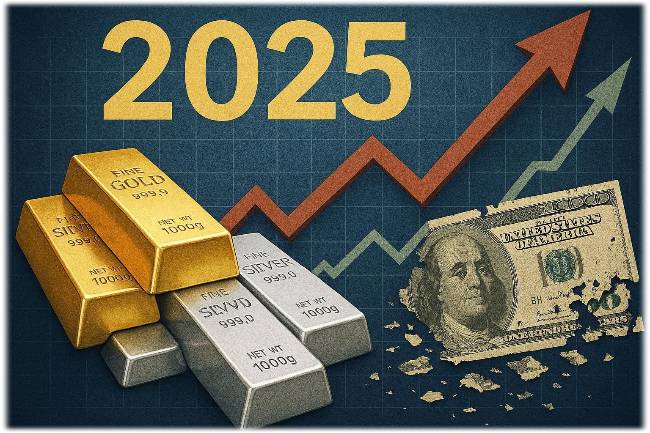
Precious metals markets delivered extraordinary gains in 2025, with silver climbing from roughly $30 per ounce at the year’s start to over $72 by late December, marking a 142% year-to-date increase.
Gold followed suit, posting gains exceeding 70% amid record highs that drew attention from central banks, institutions, and retail investors alike.
These surges reflect growing public and institutional recognition of fiat currency pressures, including persistent inflation and eroding trust in traditional financial systems, though no specific investment outcomes are implied.
Record-Breaking Market Performance
Price Milestones
Silver shattered its 2012 peak by surpassing $50 per ounce earlier in the year before accelerating to $72, a level fueled by physical demand rather than purely speculative fervor.
Gold’s rally mirrored this trajectory, achieving all-time highs of just over $4,500 per ounce as buying activity remained robust even through December’s holiday period.
These milestones marked 2025 as a pivotal year, with silver’s performance outpacing gold’s in percentage terms.
Shift from Speculation to Fundamentals
Unlike the 2011 silver spike driven by paper trading speculation, 2025’s advances stemmed from tangible supply-demand imbalances and heightened awareness of monetary devaluation.
Retail demand persisted into year-end, underscoring a broader shift where individuals confronted the diminishing purchasing power of currencies like the U.S. dollar, euro, and pound.
This evolution highlights how market dynamics can evolve with changing economic realities.
Inflation’s Personal Impact
Everyday Erosion
Inflation has outstripped returns on conventional savings throughout 2025, complicating long-term planning for pensions and household finances.
Holiday spending, such as Christmas expenses, serves as a stark annual benchmark, with consumers across multiple currencies reporting higher costs compared to prior years.
This erosion transforms savings from a source of security into one of anxiety for many households.
Broader Monetary Concerns
Fiat currencies, often likened to “sand money” for their gradual value loss, face scrutiny amid controls like proposed digital IDs in the UK and bank access restrictions in regions such as Vietnam.
These developments amplify perceptions of vulnerability in digital and paper-based wealth, prompting educational discussions on money’s foundational properties.
Institutional and Central Bank Shifts
Central Bank De-Dollarization
Central banks acquired approximately 900-1,000 tonnes of gold in 2025, positioning global gold reserves ahead of U.S. Treasuries for the first time since 1996.
Notable actions included Russia’s addition of silver to its balance sheet and Saudi Arabia’s expanded positions, initially via exchange-traded funds.
Such moves illustrate strategic reserve diversification amid shifting global monetary landscapes.
Portfolio Reallocations
Analysts at Bank of America and Morgan Stanley recommended adjusting traditional 60/40 equity-bond portfolios to a 60/20/20 model incorporating 20% gold, effectively reducing Treasury holdings by half.
This reflects institutional efforts to mitigate risks from fiat exposure amid geopolitical strains, including conflicts in Ukraine and the Middle East, as well as U.S.-China economic tensions.
Silver’s Industrial Surge
Dual Role Evolution
Silver’s 2025 performance blended its historical monetary function—evident in select central bank holdings—with industrial applications accounting for 59% of total demand.
A structural market deficit surpassing 200 million ounces underscored this duality, as demand from emerging technologies outpaced supply.
Key Demand Drivers
Solar panel production, which has grown 140% since 2016, requires about 20 grams of silver per residential unit and could consume 150 million ounces annually by 2030.
Additional pressures arise from AI data centers (potentially 25-40 million ounces), electric vehicles, and electronics, where silver’s status as the top electrical conductor proves indispensable despite its use in trace amounts across billions of products.
Supply Chain Disruptions
Physical Shortages Emerge
Industrial manufacturers increasingly prioritize physical silver over futures contracts, viewing prices above $65 per ounce as secondary to operational continuity.
The U.S. government’s designation of silver as a critical mineral in 2025 further emphasizes its strategic role in national supply chains.
These shortages reveal the limitations of paper markets when physical delivery becomes paramount.
Direct Sourcing Trends
In October 2025, Samsung provided $7 million to restart Mexico’s La Parrilla silver mine, securing exclusive rights to its output for two years through a prepaid offtake agreement.
This mirrors China’s strategy of purchasing doré gold directly from mines in South America and Africa, circumventing exchanges and further constraining available supply.
Geopolitical and Systemic Stressors
Global Tensions
Ongoing wars and rivalries between major powers have intensified demand for assets offering physical proximity, contrasting with distant digital claims in financial systems.
Levels of geopolitical stress, comparable to historical flashpoints like the Cuban Missile Crisis, contribute to this trend without altering fundamental market mechanics.
Long-Term Pressures
Decades of supply deficits, inflation, and declining institutional trust in fiat systems persist into 2026, with no immediate resolutions in sight.
These factors educate observers on the enduring interplay between economics, technology, and global stability.
Outlook and Educational Takeaways
Persistent Dynamics into 2026
Core drivers—inflation, de-dollarization, and industrial consumption—point to continued market evolution, potentially heightening silver’s volatility due to its dual monetary-industrial profile.
Observers note that unresolved structural imbalances could sustain these patterns.
Key Lessons on Precious Metals
Gold and silver have served historically as stores of value and superior conductors, distinguishing physical ownership from paper claims vulnerable to systemic risks.
Understanding these roles provides context for their performance amid modern economic challenges, fostering informed awareness of monetary history and material science.
Disclaimer: This article provides factual information and educational content on market trends and economic factors as of late December 2025. It does not constitute investment advice, financial recommendations, or endorsements. Precious metals prices are volatile; past performance does not predict future results. Consult qualified financial professionals for personalized guidance.
 Discover Why Savvy Retirees are Diversifying Their Investment Portfolios With Gold

MEET THE RESEARCHER
Doug Young Financial Markets Researcher & Former Financial Director
- Over 20 years of experience in financial markets
- More than 15 years specializing in Gold IRAs
- Extensive expertise in precious metals trading
- Former Financial Director at World Freight Services Ltd for 16 years.
- Author of 500+ published financial research articles over 10 years
- Conducted 80+ Gold IRA company evaluations since 2011


