
Did COMEX Just Dodge a Silver Delivery Bullet?
Disclaimer: This article provides factual reporting and educational information on market events. It does not constitute investment advice, financial recommendations, or endorsements. Consult qualified professionals before making any financial decisions. Past performance does not guarantee future results.
By Doug Young – 27 February 2026
Introduction
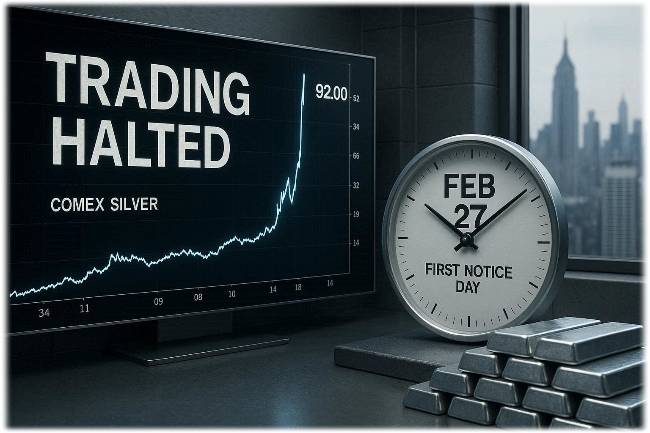
On February 25, 2026, the CME Group’s Globex platform experienced a trading halt that disrupted silver futures and other metals markets.
Silver prices had climbed to around $90.75 per ounce amid heightened volatility, drawing attention to the timing just two days before the March 2026 contract’s First Notice Day on February 27.
This event underscores the mechanics of futures trading and the pressures building in the silver market.
Key Event Facts
The halt commenced around 12:15 PM Central Time and lasted approximately 90 minutes, with metals trading resuming by 1:45 PM CT.
All-day and good-til-day orders were canceled, while good-til-canceled orders remained intact.
The exchange attributed the disruption to technical issues, a common safeguard in high-volatility environments.
Background on COMEX Silver Futures
COMEX silver futures contracts each represent 5,000 troy ounces, providing a standardized mechanism for price discovery and hedging in the precious metals market.
First Notice Day marks the point when long position holders can notify the exchange of their intent to take physical delivery, typically prompting most traders to roll over positions to later months rather than accept delivery.
This rollover process helps maintain liquidity without straining physical supply chains.
Recent Market Trends
Silver spot prices rose nearly $2.88 in the lead-up to the halt, reflecting broader bullish momentum.
Open interest stood at approximately 131,496 contracts for the week of February 17, down week-over-week but still elevated compared to historical norms, signaling sustained trader commitment.
The Halt in Detail
The pause interrupted a sequence of active trading, with immediate effects on volume and positioning in the March contract.
Upon resumption, open interest in the front-month contract dropped sharply to around 37,162 contracts, equivalent to roughly 186 million ounces.
Price and Volume Effects
Prices had been testing resistance levels near $91–$92 per ounce when the halt occurred, halting upward momentum.
Post-resumption, approximately 31,000 contracts settled rapidly, representing about 159 million ounces in notional value, as traders adjusted positions.
Inventory and Delivery Pressures
As of late February, COMEX vaults held about 86–88 million ounces of registered silver available for delivery, alongside 276–278 million ounces eligible but not immediately deliverable, for a total of roughly 366 million ounces.
This translates to a registered coverage ratio of about 0.14 times open interest and 0.56 times using total stocks, highlighting potential strain if delivery demands spike.
Historical Comparisons
Full-year deliveries in 2025 reached 474 million ounces, double the previous year’s volume, with January 2026 alone accounting for 49 million ounces.
These figures occur against a backdrop of multi-year structural supply deficits in the physical market.
Regulatory and Exchange Mechanisms
Exchanges employ circuit breakers and trading pauses to mitigate extreme volatility and ensure orderly markets.
Margin requirements for silver futures, recently adjusted to around $25,000 per contract following December advisories, help limit excessive leverage during turbulent periods.
Margin and Leverage Role
Higher margins act as a buffer by requiring more capital to maintain positions, often prompting speculators to exit and reducing the risk of cascading liquidations.
Broader Market Implications
Such disruptions can influence global price linkages, including arbitrage between COMEX, London, and Shanghai markets, where physical delivery norms differ.
Elevated physical premiums in some regions already reflect divergent supply dynamics.
Competing Market Data
Silver’s industrial applications, particularly in solar panels and electronics, continue to drive baseline demand amid these futures tensions.
Exchange tools like cash settlements provide flexibility to resolve mismatches without physical delivery.
Expert Perspectives
Market analysts note that while the halt revealed operational stresses, it aligns with routine volatility controls rather than systemic failure.
Commitments of Traders reports from the CFTC offer further insight into positioning by commercials versus speculators.
Conclusion: Watching the Delivery Window
As February 27’s First Notice Day unfolds, upcoming delivery notices and inventory updates will clarify immediate pressures.
Understanding these futures dynamics illustrates the distinction between paper contracts and physical markets, where supply constraints play out differently.
Disclaimer: This article provides factual reporting and educational information on market events. It does not constitute investment advice, financial recommendations, or endorsements. Consult qualified professionals before making any financial decisions. Past performance does not guarantee future results.
 Discover Why Savvy Retirees are Diversifying Their Investment Portfolios With Silver
MEET THE RESEARCHER
Doug Young Financial Markets Researcher & Former Financial Director
- Over 20 years of experience in financial markets
- More than 15 years specializing in Gold IRAs
- Extensive expertise in precious metals trading
- Former Financial Director at World Freight Services Ltd for 16 years.
- Author of 500+ published financial research articles over 10 years
- Conducted 80+ Gold IRA company evaluations since 2011


