
Gold Outperforms Stocks Amid Bubble Warnings
Disclaimer: This article is for informational purposes only and does not constitute financial advice. Readers should consult qualified professionals for investment decisions.
By Doug Young – 06 November 2025
Gold Outperforms Stocks Amid Bubble Warnings
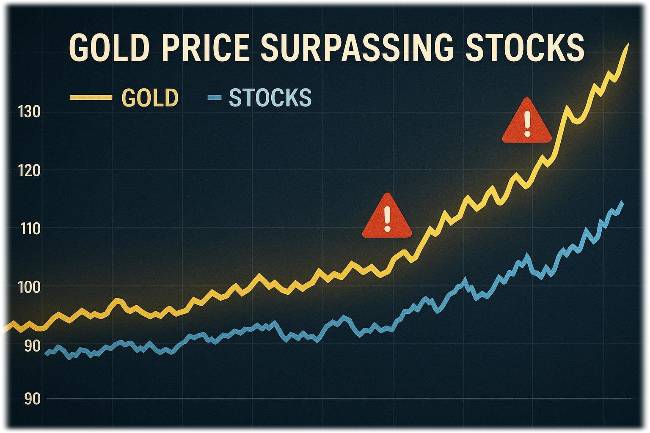
In 2025, gold prices have surged past major equity indices, marking a dramatic divergence from historical patterns.
Unlike previous cycles where gold outperformed stocks only amid crises, this year the precious metal has reached new heights in tandem with equity market rallies, prompting widespread debate about the underlying forces and risks shaping global investment portfolios.
Market Overview: 2025 Price Movements
Gold has exceeded $4,000 per ounce for the first time, while the S&P 500 has crossed the 6,700 mark, reporting year-to-date gains of 48% for gold and 15% for the S&P 500 as of early November.
This level of gold outperformance is highly unusual and represents the seventh worst relative year for equities compared to gold since 1973.
Investors are closely watching these figures as both asset classes achieve record highs.
Understanding the Bubble Warnings
The cyclically adjusted price-to-earnings (CAPE) ratio, a prominent measure of stock market valuation, has hovered above 40 for months, levels last witnessed during the dot-com bubble.
Such high valuations often signal excessive optimism and raise concerns about future corrections. Historical parallels with earlier market bubbles warn that concentrated portfolios may be exposed to significant risk if the trend reverses.
Gold as an Independent Asset: Correlation and Safe Haven Dynamics
Gold’s reputation as an independent asset is supported by its historically low correlation with equities, typically fluctuating between 0.1 and 0.3 in normal conditions and often turning negative during market turmoil.
During prolonged bear markets or systemic crises, such as those in 2008, gold’s negative correlation can reach -0.5 or below, underscoring its safe haven appeal.
Central banks continue to hold substantial gold reserves—up to 51,000 metric tonnes globally—citing gold’s diversification advantage and its protective qualities against market failures.
Institutional and Global Perspectives
Institutions and central banks have notably increased allocations to gold in 2025, aiming to reduce dependence on single currencies like the U.S. dollar.
ETF flows and official gold purchases have surged, reflecting strategic attempts to hedge against currency risk and the inflationary effects of global monetary policy shifts.
Sovereign wealth funds, pension funds, and hedge funds have all adjusted their reserve strategies to emphasize broader diversification and risk management.
Historical Perspective: Previous Gold Outperformance Episodes
Major gold bull markets frequently coincide with periods of intense uncertainty and monetary regime changes, such as the 1970s and post-2000 periods.
Historical analysis reveals that recovery times for equities, when measured in gold ounces, can stretch for decades; after the 1929 crash, the Dow took 30 years to recover in gold terms, and market cycles often feature prolonged stretches where gold leads asset returns.
These long-term cycles remind investors that asset leadership rotates and that past performance does not guarantee future results.
Macro Trends and What Drives Investor Anxiety
Several factors have contributed to gold’s dramatic rise in 2025, including inflationary pressures, declining dollar value, geopolitical instability, and heightened investor anxiety.
Online discussions and economic commentators suggest that many view gold’s surge as a sign of broader uncertainty, with some likening market conditions to the lead-up to the 2008 financial crisis.
Educational Takeaways: Diversification and Risk Management
Gold’s performance underscores the importance of diversification and robust risk management in portfolio construction.
While gold offers protection against systemic shocks and correlates negatively with equities during stress periods, modern portfolio theory advocates blending assets to manage risk effectively.
Investors and institutions typically benefit from allocating across multiple asset classes, appreciating that market cycles and leadership evolve over time.
Conclusion: Interpreting the Gold Run in Historic Context
The extraordinary run of gold prices in 2025 has captured the attention of investors and analysts alike.
While both gold and stocks have notched historic highs, the presence of bubble warnings, extreme valuations in equities, and rising global uncertainty reinforce the need for a balanced, fact-based approach to investing.
The present environment offers important lessons in risk awareness and asset diversification, emphasizing that market cycles are persistent and that no single asset class dominates forever.
Disclaimer: This article is for informational purposes only and does not constitute financial advice. Readers should consult qualified professionals for investment decisions.
 Discover Why Savvy Retirees are Diversifying Their Investment Portfolios With Gold
MEET THE RESEARCHER
Doug Young Financial Markets Researcher & Former Financial Director
- Over 20 years of experience in financial markets
- More than 15 years specializing in Gold IRAs
- Extensive expertise in precious metals trading
- Former Financial Director at World Freight Services Ltd for 16 years.
- Author of 500+ published financial research articles over 10 years
- Conducted 80+ Gold IRA company evaluations since 2011


