
Silver’s Revenge: From Forgotten Metal to 2026 Star
Disclaimer: This article is for general informational and educational purposes only and does not constitute financial, investment, tax, or legal advice. You should conduct your own research and, where appropriate, consult a qualified, regulated financial professional before making any decisions that could affect your finances.
By Doug Young – 02 January 2026
Introduction: From Backwater to Front Page
Silver’s decade of neglect
For much of the 2010s and early 2020s, silver sat in the shadow of both equities and gold. It lagged major stock indices and often failed to confirm gold’s rallies, reinforcing its reputation as a volatile side show rather than a core asset.
That long period of underperformance left many market participants viewing silver as an industrial afterthought rather than a strategic metal.
The picture changed markedly in 2025. Silver began setting new highs in several currencies and outperformed broad equity benchmarks after more than a decade of relative stagnation.
At the same time, the global silver market remained in a structural deficit for multiple consecutive years, with annual demand exceeding mine production and recycling.
That combination of fresh price behavior and persistent deficits has put silver back on front pages as 2026 begins.
Why silver matters in 2026
Silver today occupies a rare position at the intersection of two powerful themes: the global energy and technology transition on one side, and concerns about debt, inflation, and financial stability on the other.
It is a critical input for solar panels, electric vehicles, and advanced electronics, while also retaining a long history as a monetary metal and store of value.
This news item examines the forces reshaping the silver market in 2026. The goal is to inform readers about structural supply and demand trends, geopolitical shifts, and macroeconomic context. It is not intended to promote any investment product or strategy, nor to provide personalized financial advice.
Breaking Out: Silver’s Market Behavior in 2025–2026
The end of a long stalemate
For roughly 11 years, both gold and silver oscillated in broad ranges against the S&P 500.
Metals rallied and retraced, but the overall structure resembled a horizontal band: when gold rose, it often surrendered gains; when equities surged, metals frequently went quiet.
Silver’s ratio to gold also spent years at historically depressed levels.
That pattern fractured in late 2025. Ratios of gold to the S&P 500 and gold miners to the S&P broke out of long‑standing ranges, and silver followed.
Silver also began to rise relative to gold from low levels, suggesting a re‑rating of the metal after years in the doldrums.
To many analysts, 2025 looked less like the climax of a move and more like the removal of a lid that had constrained silver’s role in portfolios.
Record prices and tightening liquidity
As prices pushed higher, signs of strain appeared in parts of the market’s plumbing.
Periods of backwardation, where spot prices trade above near‑dated futures, became more frequent, indicating pockets of short‑term tightness in physical supply.
At times, exchange vault inventories showed stress as large deliveries drew down available stocks.
These developments unfolded against a broader backdrop of persistent deficits. When a market is drawing down above‑ground inventories year after year, episodes of price spikes and liquidity tightness become more likely.
That is the context in which silver entered 2026: not merely more expensive, but trading within a system that appears to be gradually losing its buffers.
Structural Deficits: When Demand Outruns Supply
Five years of deficits
A structural deficit occurs when underlying demand persistently exceeds the combined contribution of mine supply and recycling, forcing the market to draw from existing above‑ground stocks.
In recent years, the global silver market has experienced such deficits several years in a row, as industrial and investment demand outpaced supply.
Initially, accumulated inventories and previously idle material can bridge the gap. Over time, however, repeated deficits reduce that cushion. Once easily mobilized stocks are depleted or locked away in long‑term holdings, the market becomes more sensitive to incremental shifts in supply or demand.
That vulnerability is increasingly evident in how silver trades around periods of strong industrial or physical investment buying.
Supply that struggles to respond
Unlike gold, which is typically mined from deposits where gold is the main economic driver, most silver is produced as a by‑product. Roughly 70% of annual silver output comes from operations whose primary focus is copper, lead, zinc, or gold.
In those mines, silver revenues help, but they do not determine whether a project is built, expanded, or shut down.
That structure constrains the supply response. Higher silver prices alone do not automatically trigger a wave of new production, because the economics and decisions are anchored in other metals.
At the same time, grades at many primary silver deposits have been declining. New projects face lengthy permitting timelines, environmental scrutiny, and substantial capital requirements.
Even in a strong price environment, bringing new primary supply online can take many years.
The limits of recycling
Recycling provides an important contribution to total silver supply, especially from industrial scrap, jewelry, and silverware. However, the growth of new demand sectors such as photovoltaics and advanced electronics has not yet been matched by a corresponding increase in end‑of‑life recovery.
Solar modules and many electronic components have long service lives, often stretching over decades. That means much of the silver embedded in installations deployed today will not return to the supply pool for a long time.
Technical challenges and economics also limit the pace at which recycling can scale. At current technology and price levels, recycling can alleviate some pressures but is unlikely, by itself, to eliminate structural deficits in the near term.
Industrial Engine: Silver in the Energy and Tech Transition
Why silver is hard to replace
Silver is the most conductive metal for electricity and heat, a property that underpins its wide use in electronics, solar cells, and specialized industrial applications. It is used in contacts, pastes, solders, and various components where efficiency and reliability are essential.
Substitution with cheaper metals such as copper or aluminum is technically possible in some contexts. However, alternative materials typically reduce performance, increase energy losses, or shorten product life.
In many high‑value applications—such as advanced semiconductors or critical electrical contacts—the cost savings from using less silver can be overshadowed by the performance and reliability trade‑offs.
Solar photovoltaics: a growing share
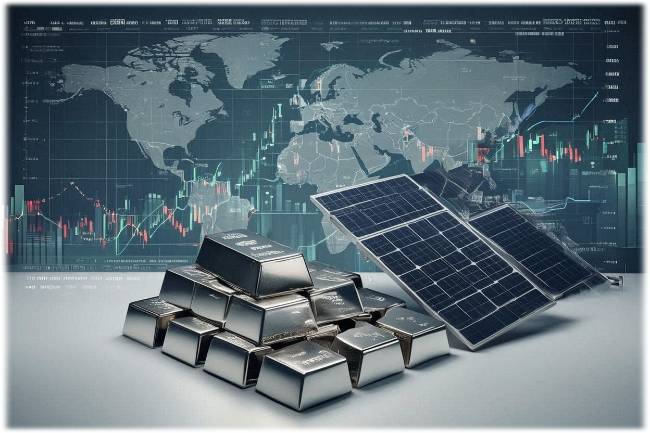
Solar photovoltaics have become one of the fastest‑growing sources of silver demand. Silver paste is used in the conductive grid lines of many solar cells. As global solar capacity has expanded, so has the sector’s consumption of silver.
Several industry studies suggest that, if current trends continue, PV could account for a very large share of global silver demand by the end of this decade.
Manufacturers are working to thrift silver usage per cell, but the picture is complex. High‑efficiency technologies—such as TOPCon, heterojunction (HJT), and next‑generation tandem cells—can sometimes require more silver per unit area, even as overall efficiency rises.
As installed capacity grows, total silver use in PV is expected to remain substantial, and in many scenarios, to increase rather than fall.
Electric vehicles and data centers
Silver also plays a role in the electrification of transport and the digitization of the economy.
In electric vehicles, silver is employed in power electronics, on‑board chargers, battery management systems, and various sensors and control units. As EV penetration rises and charging networks expand, those uses scale with them.
Data centers, 5G infrastructure, and AI‑related hardware depend on high‑reliability electrical systems, circuit boards, and components where silver can be a key material.
In these environments, uptime and efficiency matter more than shaving a small amount off material costs. That makes demand from such sectors comparatively resilient to moderate price changes in the underlying metal.
Inelastic industrial demand
Economists describe demand as “inelastic” when changes in price have only a limited effect on the quantity consumed.
In many industrial applications, silver behaves this way. The amount of silver in a finished product is typically small relative to the product’s total value. For a manufacturer, moving from roughly one to a few dollars’ worth of silver per device may have negligible impact on the overall bill of materials.
The greater operational risk is not a slightly higher input cost, but the possibility of not securing enough material at all.
As a result, many industrial users treat silver more as a strategic input to secure than a commodity to minimize, reinforcing its role as a critical material in key value chains.
Geopolitics and Trade: China, India, and the Global Flow of Silver
China’s pivot to strategic control
China has long been a major player in the silver market, not only as a producer but also as a refiner and exporter.
For years, Chinese exports of refined silver helped moderate price spikes by providing additional supply during periods of tightness. That “quiet stabilizer” role helped keep global prices closer to production costs.
The policy landscape is now shifting. From 2026, China is introducing a new licensing regime for silver exports, treating the metal more explicitly as a strategic resource.
Under this framework, only approved entities will be able to export refined silver, and overall volumes may be restrained compared with prior years.
For a market that relies heavily on Chinese refined supply, such changes have the potential to tighten global availability and amplify regional price differentials.
India’s rise as consumer and producer
At the same time, India is emerging as a significant force on the demand side.
The country has rapidly expanded its solar manufacturing industry, supported by government incentives aimed at boosting domestic production of panels and reducing reliance on imports. That industrial build‑out requires steady access to silver for PV manufacturing.
India has also seen growing interest in silver as an investment vehicle. Holdings in silver‑linked exchange‑traded products have reportedly increased sharply, and imports have risen as local demand outstrips prior stocks.
This dual role—as both a manufacturer in need of silver for energy transition projects and a consumer of silver‑related investment products—positions India as a key driver of global flows.
East–West divergence in physical demand
A broader East–West divergence is taking shape.
In several Asian markets, including India and financial hubs such as Singapore, there is a strong tradition of holding precious metals in physical form. In recent years, that preference has increasingly extended to silver, not just gold.
Differences in inflation experiences, currency volatility, and trust in financial institutions also influence behavior.
Households and institutions in some Eastern economies may be more inclined to diversify into tangible assets when confronted with rising living costs or uncertain policy environments.
That divergence means physical accumulation can be stronger in the East even when sentiment in Western markets remains more cautious or focused on financial instruments.
Monetary Narrative: Silver as Financial Safety Valve
From commodity to monetary hedge
Alongside its industrial story, silver is undergoing a perceptual shift.
After years of being treated primarily as a neglected industrial commodity, it is increasingly being discussed in the same breath as gold when investors consider potential hedges against currency debasement or financial instability.
One indicator of this shift is the way many observers describe silver in ounces rather than in local currency terms. Thinking in ounces emphasizes the metal’s role as a store of value and signals skepticism about the future purchasing power of fiat currencies.
While such attitudes do not guarantee price outcomes, they do change the character of demand, adding a monetary layer on top of industrial usage.
Debt, deficits, and bond‑market strains
Silver’s renewed monetary narrative is unfolding against a demanding macroeconomic backdrop.
Major economies are carrying historically high debt loads, and fiscal deficits in some countries have reached levels that would have been considered extraordinary in prior decades. That debt must be rolled over at interest rates that are higher than those prevailing during the era of ultra‑low yields.
Bond markets have shown occasional signs of strain, from episodes of volatility in Japanese government bonds as domestic yields rise, to periodic widening of sovereign spreads in Europe, to concerns about long‑term fiscal trajectories in the United States.
In such an environment, questions about the sustainability of current policy frameworks naturally arise. Those questions often prompt renewed interest in assets perceived as outside the traditional financial system, including precious metals.
Retail sentiment and delayed reactions
Historically, household responses to financial stress can be delayed but powerful.
Stock markets may spend months grinding sideways near highs before a more pronounced downturn forces investors to confront the vulnerability of their retirement accounts and savings.
When that realization comes, reactions can be abrupt, especially if they coincide with rising living costs.
In the case of silver, there is an additional psychological twist. Retail investors sometimes interpret price moves as the metal “getting stronger,” when in many cases part of the adjustment reflects weakening currency purchasing power.
Over time, as this distinction becomes clearer, demand for assets seen as hedges can accelerate. That dynamic is a key part of the monetary story developing around silver.
Market Microstructure: Futures, Inventories, and Price Discovery
Futures exchanges and physical delivery
Futures exchanges have historically been venues for hedging and speculation, with relatively few contracts resulting in physical delivery.
In recent years, that pattern has begun to change in silver. A larger share of contracts on some exchanges has been settled by delivery, meaning more participants are using futures as a mechanism to secure actual metal.
This shift places additional importance on exchange vault inventories. When more clients stand for delivery, warehouse stocks fall unless replenished by new inflows.
The balance between paper claims and available physical becomes more closely watched, and delivery cycles can exert a direct influence on sentiment and, at times, price behavior.
Shifting open interest and participant mix
Another notable development has been the behavior of open interest—the total number of outstanding futures contracts—during price rises.
On several occasions, open interest has tended to decline as prices moved higher. That pattern suggests some leveraged or short‑term participants were reducing exposure rather than adding to it.
At the same time, industrial users and longer‑term holders appear increasingly focused on using futures to secure supply rather than to speculate on short‑term price moves.
A market dominated by such participants tends to respond differently to news, with volatility that reflects real supply concerns rather than purely financial positioning.
Backwardation, premiums, and signals
Episodes of backwardation, where prompt delivery prices exceed those for future delivery, are a key signal in this environment. They often indicate that immediate physical metal is valued more highly than promises of future supply, pointing to short‑term tightness.
While backwardation can be temporary, its increasing frequency in silver is consistent with a market operating with thinner buffers.
Regional physical premiums tell a related story.
In some Asian markets, the price paid for bars or coins above international benchmarks has periodically widened, reflecting strong local demand and logistics constraints.
As these premiums become more relevant to end users, they play a larger role in overall price discovery alongside futures benchmarks.
Risks, Uncertainties, and What Could Change the Story
Technological shifts and substitution
No trend in commodities is guaranteed, and silver is no exception.
On the demand side, continued research into material science could yield more efficient use of silver or viable substitutes in key applications. If new conductive materials or cell designs allow similar performance with significantly less silver, long‑term intensity per unit of output could fall.
Changes in technology pathways also matter. If future solar architectures or energy‑storage solutions rely less on silver‑intensive components, the growth trajectory of industrial demand could differ from current expectations.
Similarly, shifts in electronics design, miniaturization trends, or new manufacturing techniques could alter how much silver is required per device.
Supply‑side surprises
On the supply side, sustained high prices and improved project economics could eventually encourage new mine development or expansions that are not currently viable. Discoveries of new deposits or technological advances in extraction could change the outlook for primary silver production.
Recycling could also expand if higher price levels and policy support make more end‑of‑life recovery economically attractive. Over time, better collection systems, improved refining technology, and regulatory incentives might increase the share of silver reclaimed from discarded electronics, solar modules, and other products. Such developments would not eliminate deficits overnight but could mitigate them.
Macro and policy reversals
The macroeconomic context is another key source of uncertainty.
If inflation pressures ease, fiscal positions improve, or monetary policy paths stabilize, the urgency of seeking monetary hedges could diminish. In that scenario, the monetary narrative around silver might soften even as its industrial role persists.
Geopolitical and policy decisions can also change course. Export controls on strategic materials may be tightened or relaxed, trade relationships can shift, and industrial policies may evolve as governments reassess priorities.
Any of these changes could alter trade flows, investment patterns, and the balance of power within the silver market.
How Readers Can Use This Information (Without Advice)
Understanding silver as a complex asset
Taken together, these developments show silver as a complex asset shaped by overlapping industrial, geopolitical, and monetary forces.
Its price reflects not only mine output and fabrication demand, but also policy decisions in major economies, technology choices in energy and electronics, and the shifting preferences of investors worldwide.
Outcomes remain uncertain. Structural deficits, export controls, and rising industrial use point in one direction, while potential technological advances, supply responses, and macro shifts point in others.
Past performance and recent breakouts, while notable, do not guarantee similar behavior in the future.
Questions for personal due diligence
For readers, the key value of this information lies in framing questions rather than providing answers tailored to individual circumstances.
How concentrated is exposure to any single asset or theme? How might changes in energy policy, technology, inflation, or interest rates affect broader financial plans? What role, if any, should tangible assets play relative to equities, bonds, and cash?
These are inherently personal questions that depend on time horizons, risk tolerance, income needs, and regulatory environments.
Disclaimer: This article is for general informational and educational purposes only and does not constitute financial, investment, tax, or legal advice. You should conduct your own research and, where appropriate, consult a qualified, regulated financial professional before making any decisions that could affect your finances.
 Discover Why Savvy Retirees are Diversifying Their Investment Portfolios With Silver
MEET THE RESEARCHER
Doug Young Financial Markets Researcher & Former Financial Director
- Over 20 years of experience in financial markets
- More than 15 years specializing in Gold IRAs
- Extensive expertise in precious metals trading
- Former Financial Director at World Freight Services Ltd for 16 years.
- Author of 500+ published financial research articles over 10 years
- Conducted 80+ Gold IRA company evaluations since 2011


