
Precious Metals Correction: Bull Market Still Alive?
Disclaimer: This article provides general information and historical market analysis for educational purposes only. It does not constitute investment, financial, or legal advice. Past performance is not indicative of future results. Consult a qualified financial advisor before making any decisions.
By Doug Young – 05 February 2026
Introduction
Precious metals markets experienced a sharp downturn in late January 2026 after reaching unprecedented highs, prompting questions about the durability of the ongoing bull market.
Gold and silver prices plummeted in one of the most dramatic single-day declines in decades, erasing significant gains from prior weeks.
This article examines the sequence of events, underlying drivers, and broader context to provide an educational overview of the correction’s mechanics and market dynamics.
Recent Price Movements
Gold’s Record High and Decline
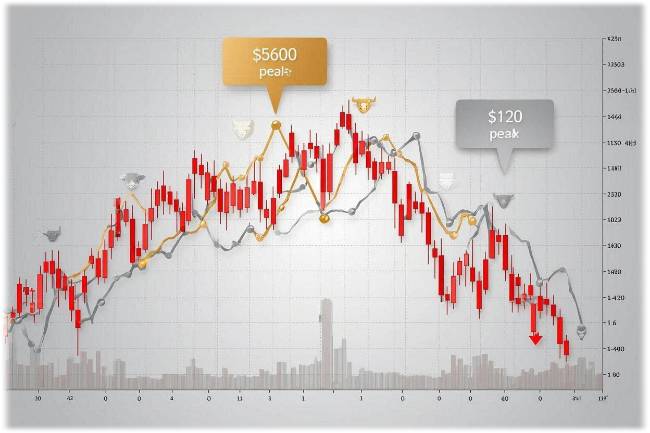
Gold futures on the Comex exchange surged above $5,600 per ounce in late January 2026, marking a historic peak driven by speculative momentum.
On January 30, prices fell more than 12%, settling sharply lower amid forced liquidations. By early February, gold had stabilized in the $5,000 to $5,500 range, reflecting partial recovery but elevated volatility compared to historical norms.
Silver’s Extreme Volatility
Silver prices exhibited even greater swings, climbing to over $120 per ounce before crashing approximately 31% on January 30—the steepest one-day drop since 1980.
This movement underscored silver’s higher sensitivity, or beta, to gold price shifts, amplified by its smaller market size and leveraged trading.
Stabilization followed in physical markets, where premiums over spot prices held firm.
Triggers of the Correction
Macroeconomic Catalysts
President Donald Trump’s nomination of Kevin Warsh, a former Federal Reserve governor viewed as hawkish on inflation, as the next Fed chair sparked a rapid reassessment of monetary policy expectations.
Markets scaled back bets on aggressive interest rate cuts, boosting U.S. dollar strength and Treasury yields, which raised the opportunity cost of holding non-yielding precious metals. These shifts pressured commodity prices broadly.
Technical and Market Mechanics
Overcrowded leveraged positions in futures markets unraveled as exchanges like the CME raised margin requirements, triggering stop-loss orders and forced sales.
The timing—end-of-month on a Friday ahead of a weekend liquidity gap—intensified the cascade, with traders unable to adjust positions until markets reopened.
Notably, physical gold and silver markets showed resilience, with premiums diverging positively from paper futures.
Underlying Market Fundamentals
Central Bank Activity
Central banks continued robust gold purchases into late 2025 and early 2026, with net buying exceeding 750 tonnes annually since 2022, led by institutions diversifying reserves amid geopolitical tensions and dollar concerns.
This structural demand provided a supportive backdrop, unaffected by the short-term futures flush.
Supply-Demand Dynamics
Silver faced persistent deficits from surging industrial use in solar panels, electric vehicles, and electronics, outpacing mine supply.
Gold benefited from its role as a safe-haven asset amid rising sovereign debt levels—now over $36 trillion in the U.S.—and ongoing de-dollarization trends in global trade.
Analyst Perspectives and Forecasts
Short-Term Outlook
Analysts anticipate continued volatility in February 2026, with gold finding technical support near $4,500 to $4,800 per ounce.
Silver has found support around $80 per ounce.
Recovery potential hinges on renewed rate cut pricing or geopolitical escalations, though near-term headwinds from index rebalancing persist.
Longer-Term Views
Major banks forecast gold reaching $5,000-$6,000 in 2026, citing enduring demand drivers. JP Morgan is more bullish and has recently upped its 2026 year-end gold projection to $6,300.
Recognised industry insiders such as Mike Maloney and Michael Oliver have discussed potential gold prices of $8,000-$8,500 by the end of 2026, and silver prices of $200 per ounce within 2026. They both refer to the current pullbacks as buying opportunities as both gold and silver enter new price resets.
Risks include stronger-than-expected economic growth curbing safe-haven flows or equity market disruptions spilling over.
Historical Context
Precious metals bull markets have historically featured sharp corrections to clear speculative excess, as seen in prior cycles like 2011 or the early 2000s rally.
These resets often precede new highs when fundamentals remain supportive, distinguishing technical pullbacks from fundamental reversals.
Key Takeaways
The January 2026 correction highlighted the interplay between leveraged speculation and enduring demand trends in precious metals.
Key indicators to monitor include central bank reserve data, industrial consumption figures, and macroeconomic policy signals.
Markets carry inherent risks, and individuals should conduct independent research or consult qualified professionals when evaluating economic developments.
Disclaimer: This article provides general information and historical market analysis for educational purposes only. It does not constitute investment, financial, or legal advice. Past performance is not indicative of future results. Consult a qualified financial advisor before making any decisions.
 Discover Why Savvy Retirees are Diversifying Their Investment Portfolios With Gold

MEET THE RESEARCHER
Doug Young Financial Markets Researcher & Former Financial Director
- Over 20 years of experience in financial markets
- More than 15 years specializing in Gold IRAs
- Extensive expertise in precious metals trading
- Former Financial Director at World Freight Services Ltd for 16 years.
- Author of 500+ published financial research articles over 10 years
- Conducted 80+ Gold IRA company evaluations since 2011


