


Gold IRA Transfer vs. Rollover: Key Differences, Tax Rules, and Risks



Last updated: 07 November 2026
Important: This article is educational and does not constitute tax, legal, or investment advice. Rules can vary based on account type, employment status, plan documents, and individual circumstances; consult a qualified tax professional or fiduciary financial advisor before moving retirement assets.
The main difference between a Gold IRA transfer and a Gold IRA rollover lies in where the funds come from and how they move between custodians. Each process moves retirement funds into a self-directed precious metals IRA, but they differ significantly in mechanics, tax rules, and risk levels.
Key Takeaways
-
A Gold IRA transfer is a trustee-to-trustee movement of funds between IRA custodians. Because you never receive the money, it is generally not a taxable distribution and is not subject to the 60-day rollover deadline or the one-rollover-per-12-month limit.
-
A Gold IRA rollover typically moves eligible assets from an employer plan—such as a 401(k), 403(b), or pension—into a self-directed Gold IRA. A direct rollover sends the funds straight to the new custodian, while an indirect rollover pays the funds to you first.
-
Direct rollovers are usually the lower-risk option for moving money from an employer plan because they avoid mandatory 20% federal withholding and the 60-day redeposit deadline.
-
Indirect rollovers carry stricter rules: you generally have 60 days to redeposit the full distribution, and an IRA-to-IRA indirect rollover is limited to one per 12-month period across all of your IRAs.
-
A transfer is generally appropriate when moving funds from one IRA to another of the same type, such as a Traditional IRA to a Traditional Gold IRA or a Roth IRA to a Roth Gold IRA. Converting a Traditional IRA to a Roth Gold IRA is a Roth conversion, not a simple transfer.
-
Before funding a Gold IRA, verify that the custodian, precious-metals dealer, storage arrangement, and eligible metals comply with IRS requirements. Review all setup, annual, storage, insurance, purchase, and liquidation fees before committing.
-
A Gold IRA transfer or rollover does not make gold a guaranteed hedge against inflation or market losses. Consider your retirement timeline, risk tolerance, fees, liquidity needs, and overall asset allocation before moving retirement funds.
Podcast:
Gold IRA Transfer vs. Rollover: Which Is Right for Your Retirement Funds?
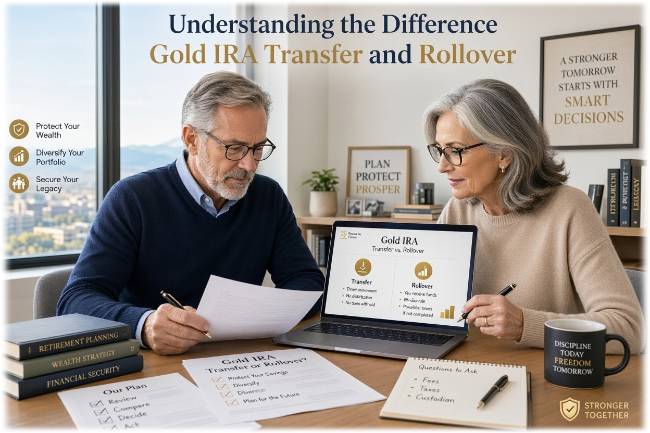
A Gold IRA transfer moves funds directly from one IRA custodian to another, while a Gold IRA rollover moves money from an employer retirement plan—such as a 401(k), 403(b), or pension—into a self-directed Gold IRA. The distinction matters because transfers and direct rollovers avoid distribution and withholding issues, whereas an indirect rollover has strict 60-day and one-per-year rules.
Quick Comparison
| Feature | Gold IRA Transfer | Direct Gold IRA Rollover | Indirect Gold IRA Rollover |
|---|---|---|---|
| Typical source | Existing Traditional or Roth IRA | 401(k), 403(b), 457(b), pension, or other eligible employer plan | 401(k), 403(b), pension, or IRA |
| Who receives the funds | New IRA custodian | New Gold IRA custodian | You, temporarily |
| IRS classification | Trustee-to-trustee transfer | Direct rollover | Indirect rollover |
| Federal tax withholding | None | None | Generally 20% on eligible rollover distributions from employer plans |
| 60-day completion deadline | No | No | Yes |
| One-per-12-month limit | No | No | Yes for IRA-to-IRA rollovers |
| Taxable if completed correctly | No | No | No, if the full amount is redeposited within 60 days |
What Is a Gold IRA Transfer?
A Gold IRA transfer is a custodian-to-custodian, or trustee-to-trustee, movement of retirement assets. You instruct your current IRA custodian to send funds directly to the custodian of your new self-directed Gold IRA; you do not receive the money personally
This method is generally available when moving between the same IRA type—for example, Traditional IRA to Traditional Gold IRA, or Roth IRA to Roth Gold IRA. Converting a Traditional IRA to a Roth Gold IRA is a Roth conversion, not a simple same-type transfer, and has separate tax rules.
Tax and Reporting Treatment
Because the assets never become a distribution to you, a trustee-to-trustee transfer is tax-free and is not treated as a rollover for the IRS’s one-rollover-per-12-month restriction.
There is also no 60-day redeposit deadline because you never personally receive the funds. The IRS specifically states that a check sent from one trustee to another—even if you deliver it—is still a transfer, provided it is made payable to the new trustee rather than to you.
When a Transfer Makes Sense
A transfer is usually the simplest route if you already have an IRA and want to hold physical gold, silver, or other eligible precious metals through a self-directed Gold IRA. It avoids withholding, missed-deadline risk, and the annual rollover limit.
What Is a Gold IRA Rollover?
A Gold IRA rollover generally refers to moving eligible assets from an employer-sponsored retirement plan into a self-directed Gold IRA. Common source accounts include a 401(k), 403(b), governmental 457(b), or pension plan.
The term is also sometimes used informally for moving money from one IRA to another. Technically, however, an IRA-to-IRA direct movement is a transfer, while an IRA distribution paid to you and redeposited within 60 days is an indirect rollover.
Direct Rollover: The Lower-Risk Option
With a direct rollover, your former employer’s plan administrator sends the eligible distribution directly to your new Gold IRA custodian. The check may be made payable to the receiving custodian, but the key point is that the money is not paid to you personally.
A direct rollover is not subject to mandatory federal income-tax withholding, and the IRS treats it as a movement between eligible retirement accounts rather than a taxable distribution when handled correctly.
Key Benefits
-
No 20% mandatory withholding on an eligible rollover distribution.
-
No 60-day deadline for you to redeposit funds.
-
No need to replace withheld money from personal savings.
-
Generally no taxable event or early-withdrawal penalty if the rollover is properly completed.
Indirect Rollover: Higher Risk
With an indirect rollover, the plan pays the distribution to you first. You then have 60 days from the date you receive the funds to deposit the full amount into your new Gold IRA or another eligible retirement account.
For employer-plan distributions paid to you, the payer generally must withhold 20% for federal income tax, even if you intend to roll over the entire distribution. To avoid taxation of the withheld portion, you must contribute the full original distribution amount—including replacing the 20% withholding from other funds—and you can later claim a refund of any excess withholding when you file your tax return.
What Happens If You Miss the Deadline?
If you do not complete the rollover within 60 days, the amount not rolled over is generally treated as a taxable distribution. If you are under age 59½, it may also be subject to the additional 10% early-distribution tax, subject to applicable exceptions.
The IRS can waive the 60-day requirement in certain limited circumstances, such as qualifying casualty, disaster, or other eligible reasons, but it cannot waive the other requirements for a valid rollover contribution.
The One-Rollover-Per-Year Rule
The one-rollover limitation applies to IRA-to-IRA rollovers, not to direct rollovers from an employer plan to an IRA. Since 2015, you may make only one indirect rollover from an IRA to the same or another IRA in any 12-month period, regardless of how many IRAs you own.
By contrast, trustee-to-trustee transfers between IRAs are not limited, and direct rollovers from employer plans are not subject to that IRA rollover limit.
Important Gold IRA Considerations
A Gold IRA is typically a self-directed IRA that holds IRS-approved precious metals through an approved custodian. Before initiating either process, confirm:
-
Whether the receiving account is a Traditional or Roth Gold IRA, since same-type movement is simplest.
-
Whether your current employer plan permits an in-service rollover if you are still employed.
-
The custodian’s storage, insurance, setup, annual, and liquidation fees.
-
Whether the precious metals meet IRS fineness and storage requirements.
-
Whether the dealer and custodian are reputable, transparent about pricing, and provide written fee disclosures.
Practical Example
Suppose you have $100,000 in a former employer’s 401(k) and want to open a Gold IRA.
-
Direct rollover: The 401(k) administrator sends $100,000 directly to your Gold IRA custodian. No federal withholding applies, and you do not need to meet a 60-day deadline.
-
Indirect rollover: The plan sends you a check for $80,000 after withholding $20,000. To roll over the full $100,000, you must deposit $100,000 into the Gold IRA within 60 days, using $20,000 of your own money to replace the withholding.
Bottom Line
For most people moving IRA funds into a Gold IRA, a custodian-to-custodian transfer is the cleanest option. For money in a 401(k), 403(b), or pension, a direct rollover is usually safer than an indirect rollover because it avoids mandatory withholding and the 60-day deadline.

FINAL WORDS
Investing in gold can be a powerful strategy to bolster and diversify a retirement portfolio. The right Gold IRA provider can help you navigate this complex market with confidence.To help you understand options, I recently conducted a comparative market analysis of the five top performing Gold IRA Companies in .Be sure to check out my research findings before initiating any IRA rollover or transfer.Or save time and visit the top scoring company in my analysis now.
MEET THE RESEARCHERDoug Young Financial Markets Researcher & Former Financial Director
- Over 20 years of experience in financial markets
- More than 15 years specializing in Gold IRAs
- Extensive expertise in precious metals trading
- Former Financial Director at World Freight Services Ltd for 16 years.
- Author of 500+ published financial research articles over 10 years
- Conducted 80+ Gold IRA company evaluations since 2011
⚠️ IMPORTANT: All content on this website is for educational purposes only and should not be considered personalized financial advice. Always consult with a qualified financial advisor before making investment decisions.