
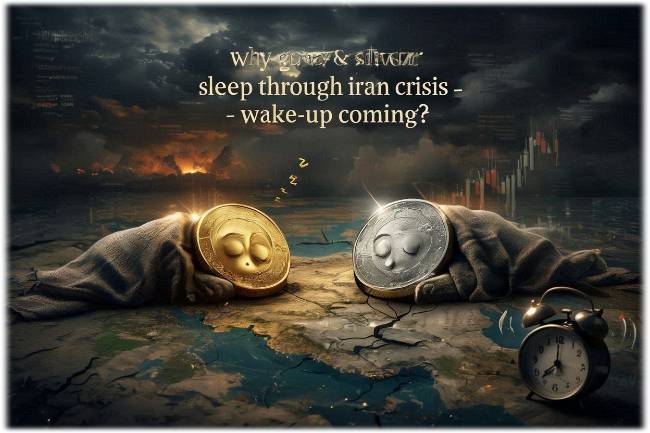
Why Gold & Silver Sleep Through Iran Crisis – Wake-Up Coming?
Disclaimer: This article presents factual market observations for educational purposes only and does not constitute financial, investment, or trading advice. Consult qualified professionals before making any decisions. Past performance does not guarantee future results.
By Doug Young – 21 April 2026
Introduction
Gold and silver prices have held remarkably steady during April 2026, even as the Strait of Hormuz crisis escalates.
This stability persists despite mounting monetary pressures worldwide. The apparent disconnect highlights short-term market mechanics overriding long-term structural shifts in precious metals dynamics.
Strait of Hormuz Crisis Explained
Timeline of Events
The crisis unfolded in late February 2026 when the US and Israel attacked Iran, leading Iranian forces to initiate actions that effectively blocked the Strait of Hormuz, a chokepoint for 25% of global seaborne oil trade.
Shipping disruptions began around February 28, halting tanker traffic and prompting international naval responses. Presently, the strait remains obstructed by both Iran and the US, with rerouting efforts straining global logistics.
Economic Ripples
Energy prices spiked initially due to the blockade, triggering volatility in natural gas and downstream sectors.
Fertilizer production costs rose sharply, as natural gas serves as a key input, while food prices followed suit amid supply chain strains.
Industries reliant on oil-derived products, from plastics to agriculture, continue to absorb higher input costs, though global inventories have cushioned immediate shocks.
Gold and Silver Market Dynamics
Current Price Snapshot
Spot gold has traded in the $4,700–$4,800 range during April 2026, reflecting modest gains but no sharp rally.
Silver prices have lingered around $75–$80 per ounce, similarly constrained despite underlying pressures.
These levels mark a period of consolidation amid broader commodity turbulence.
Suppressing Factors
Short-term liquidity drains in financial markets and a resilient U.S. dollar have capped upward momentum in gold and silver prices.
Equity indices, meanwhile, have largely ignored the compounding risks, buoyed by algorithmic trading and corporate earnings reports.
This divergence underscores how derivatives and futures markets influence spot prices in the near term.
Monetary and Central Bank Context
Global government debt has surged to historic highs, tilting policymakers toward inflationary measures to manage repayment burdens.
Central banks have responded by accumulating physical gold reserves, viewing it as a neutral asset amid currency volatility. These purchases, ongoing since 2022, total billions in holdings across major institutions.
Silver Supply Chain Vulnerabilities
Structural Deficits
Analysts project a sixth consecutive annual silver deficit for 2026, potentially widening 15% to 46.3 million ounces.
Silver production largely occurs as a byproduct of copper, lead, and zinc mining, leaving supplies vulnerable to fluctuations in those primary operations.
Industrial demand, particularly in solar panels and electronics, exacerbates the imbalance against stagnant mine output.
China’s Export Policy Shift
China announced full restrictions on sulfuric acid exports starting May 2026, a move tied to domestic priorities amid global shortages. Sulfuric acid plays a pivotal role in silver refining and copper processing, where it facilitates metal extraction.
This policy could intensify deficits by constraining refiners’ access to the chemical, particularly in regions dependent on Chinese supplies.
Why Prices Remain Contained
Short-Term Market Mechanics
Global inventories of oil, gold, silver, and related commodities have drawn down to offset disruptions, delaying price signals.
Paper markets, including futures contracts and exchange-traded funds, dominate trading volume, often detached from physical delivery realities.
This structure allows temporary suppression until physical shortages force rebalancing.
Historical Precedents
Past energy crises, such as the 1979 Iranian Revolution, saw precious metals prices lag initial shocks before surging on sustained supply fears.
Similar patterns emerged during the 2011 Libyan conflict, where metals rallied only after inventory buffers depleted.
These analogs illustrate how markets absorb geopolitical stress before reflecting it in precious metals’ pricing.
Broader Economic Implications
Industrial and Geopolitical Linkages
The Hormuz blockade cascades to helium production for semiconductors, agriculture via fertilizer costs, and even rare earth processing.
Global supply chains, already fragile from prior disruptions, face compounded risks as energy underpins nearly every industrial process.
Semiconductors and tech sectors report delays tied to these interconnected strains.
Policy and Inflation Outlook
Fiscal challenges compel governments to prioritize deficit spending, historically correlating with currency debasement risks.
Precious metals, by design, resist such erosion as non-yielding stores of value outside fiat systems. Inflation metrics, ticking higher in major economies, amplify scrutiny on assets perceived as hedges.
Looking Ahead: Potential Triggers
Escalation Scenarios
Prolonged Hormuz restrictions or military escalations could spike energy costs anew, overwhelming current stockpiles.
China’s sulfuric acid curbs, effective next month, may accelerate silver shortages if alternative suppliers falter.
Policy responses, from sanctions to trade rerouting, carry risks of further volatility.
Market Signal Indicators
Watch central bank gold purchase reports, physical delivery volumes from exchanges, and U.S. dollar index trends for breakout clues.
Shifts in COMEX eligible inventories or Shanghai futures premiums often precede rallies. Historical data shows these metrics flashing early in deficit-driven cycles.
Key Takeaways
Precious metals prices reflect a factual disconnect: robust fundamentals clash with short-term suppressors like liquidity and inventories. Historically, this rhymes; during energy crises markets have absorbed geopolitical stress before reflecting it in precious metals’ pricing.
Interconnected risks—from Hormuz to sulfuric acid—build systemic pressure across energy, industry, and finance.
This article outlines observed market conditions for educational purposes; individuals should consult qualified financial professionals for personal decisions.
Disclaimer: This article presents factual market observations for educational purposes only and does not constitute financial, investment, or trading advice. Consult qualified professionals before making any decisions. Past performance does not guarantee future results.
 Discover Why Savvy Retirees are Diversifying Their Investment Portfolios With Gold
MEET THE RESEARCHER
Doug Young Financial Markets Researcher & Former Financial Director
- Over 20 years of experience in financial markets
- More than 15 years specializing in Gold IRAs
- Extensive expertise in precious metals trading
- Former Financial Director at World Freight Services Ltd for 16 years.
- Author of 500+ published financial research articles over 10 years
- Conducted 80+ Gold IRA company evaluations since 2011


