


How Do You Convert Your IRA into a Gold IRA?



Listen to the podcast of this article:
Key Takeaways
- Converting an IRA to a Gold IRA generally requires a self-directed IRA, an eligible transfer or rollover, IRS-approved precious metals, and approved storage.
- Confirm your existing account’s eligibility and understand whether you are using a trustee-to-trustee transfer or an indirect rollover.
- Indirect rollovers generally require the funds to be redeposited within 60 days; missing the deadline may create tax consequences or penalties.
- Gold IRA metals must satisfy IRS requirements and cannot generally be stored at home or held personally while remaining within the IRA.
- Compare all fees, storage arrangements, liquidity considerations, and buyback policies before choosing a provider.
Step-by-Step Guide to Convert IRA to Gold IRA
The process to convert your IRA to a Gold IRA requires careful planning and attention to detail, but it is entirely manageable when done step-by-step.
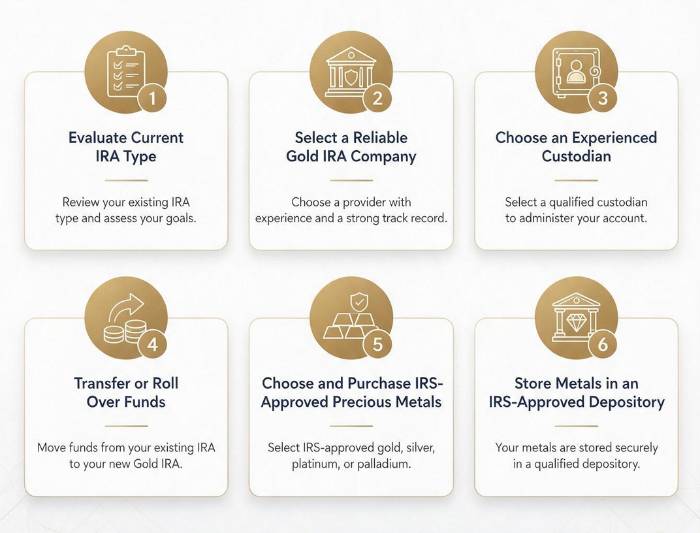
Step 1: Evaluate Your Current IRA Type
Before you begin the conversion process, you need to evaluate the type of IRA you currently have. Not all IRAs are eligible for conversion to a Gold IRA. Most importantly, you should confirm that your IRA is eligible for rollover or transfer to a self-directed IRA, which is necessary for investing in physical gold and other precious metals.
Here are the types of IRAs that are typically eligible for conversion:
- Traditional IRA
- Roth IRA
- Simplified Employee Pension (SEP) IRA
- Savings Incentive Match Plan for Employees (SIMPLE) IRA
Once you’ve confirmed your IRA type, you’re ready to proceed to the next step.
Step 2: Select a Reliable Gold IRA Company
Note: If you are unsure about the different roles played by Gold IRA Companies and Custodians in the overall Gold IRA process, I would strongly recommend that you read this article before continuing.
Choosing a reliable Gold IRA Company is a crucial step in converting your IRA to a Gold IRA.
By helping you set up a Gold IRA account with them, guiding you on funding it and assisting you with the choice and purchase of your metals, a Gold IRA company will manage the majority of the Gold IRA procedure for you. They will communicate with your custodian on your behalf during this entire process, and liaise with them when it comes to arranging the storage of your metals. A reputable Gold IRA company will take care of the majority of the work for you, including filling out around 95% of the required documentation for you when you’re setting up your Gold IRA Account and funding it.
Having evaluated a great number of Gold IRA providers over the past decade or so I am well positioned and committed to helping you understand options that will empower your decision-making process. I've meticulously compiled a comparative market analysis of the top gold IRA investing companies to help you select one that aligns with your personal circumstances and financial goals. My in-depth research and findings provide knowledge to help you make an informed choice. Explore my detailed evaluations and comparisons of the five top performing Gold IRA Companies in by clicking here. Or save time and go straight to my review of Augusta Precious Metals, the gold IRA provider that achieved the highest scoring in my evaluations.
Step 3: Select a Custodian with Gold IRA Experience
A custodian is a mandatory requirement for ensuring that you comply with all the IRS rules and regulations that govern a Gold IRA. A prerequisite of a Gold IRA is that the storage of your metals is handled by a licenced custodian. Different custodians have different levels of expertise so it’s important to select one with Gold IRA experience.
Using a custodian with whom your Gold IRA Company has a long-standing working relationship is the norm. Ultimately the choice of custodian is yours, but because both organizations will be collaborating closely on your account, it makes sense to use the one recommended by your Gold IRA Company.
Step 4: Transfer or Rollover Funds
Once your self-directed IRA account is set up, the next step is to transfer or rollover funds from your existing IRA. This process can be done in two ways: a direct transfer or a rollover. Both methods have their advantages and require careful execution to avoid penalties.
A direct transfer involves moving funds directly from your current IRA to the new self-directed IRA. This method is seamless and usually free from tax implications.
A rollover involves withdrawing funds from your existing IRA and then depositing them into the new account within 60 days. Failing to complete the rollover within this timeframe can result in taxes and penalties, so it’s crucial to adhere to the guidelines.
To begin the transfer or rollover procedure, get in touch with your present IRA custodian. Your Gold IRA Company can help you with the required documentation and walk you through the steps involved.
Step 5: Choose and Purchase Approved Precious Metals
With your funds successfully transferred, it’s time to choose and purchase approved precious metals for your IRA. The IRS has specific guidelines on the types of metals that can be held in an IRA, including purity standards and approved forms such as coins and bars. The physical precious metals that be included in a Gold IRA are gold, silver, platinum and palladium. The first two are by far the most common.
Your Gold IRA Company will be fully aware of the types of precious that can be included in a Gold IRA and will only sell you IRS approved ones.
Step 6: Store Your IRS Approved Precious Metals
Your gold must be stored in an IRS-approved depository to maintain compliance and security. This ensures that your investment is safe and protected. In accordance with IRS rules the storage must be handled by a licenced custodian. You cannot do this yourself or store your metals at home.
Your precious metals can be stored in the depository in different ways, each with different levels of security and costs. You can read about the options here:
Gold IRA Storage: Pros & Cons of Different Types
Important Considerations Before Conversion

Before you finalize your decision to convert your IRA to a Gold IRA, there are several important considerations to keep in mind. Understanding these factors will help you make an informed choice that aligns with your financial goals.
Tax Implications and Penalties
One of the most crucial aspects to consider is the potential tax implications and penalties associated with converting your IRA. Depending on the type of IRA you currently have, you may face taxes on the funds you transfer. For example, converting a traditional IRA to a Roth Gold IRA involves paying taxes on the transferred amount.
It’s advisable to consult with a tax advisor to understand the specific implications for your situation. They can provide guidance on how to minimize tax liabilities and avoid penalties.
Understanding IRS Guidelines for Gold IRAs
The IRS has strict guidelines regarding Gold IRAs, and it’s essential to understand these regulations to ensure compliance. For instance, only certain types of gold are eligible for inclusion in an IRA, and they must meet specific purity standards. Additionally, the gold must be stored in an approved depository.
Familiarizing yourself with these guidelines will help you avoid costly mistakes and ensure that your Gold IRA is set up correctly. Your Gold IRA Company and/or custodian can also provide valuable insights and support in navigating these regulations.
Costs Associated with Gold IRAs
Another important consideration is the costs associated with maintaining a Gold IRA. These can include account setup fees, annual maintenance fees, storage fees for the physical metals, and potential transaction fees when buying or selling gold and other precious metals.
It’s crucial to factor in these costs when evaluating the overall benefits of a Gold IRA. While the security and diversification benefits are significant, understanding the financial commitment involved will help you make a well-informed decision.
Liquidity of Gold and Other Precious Metals Investments
- Gold and other precious metals can be sold, but it may not be as liquid as stocks or bonds.
- The selling process may involve fees and take longer than traditional assets.
- Market conditions can affect the price you receive for your metals.
Liquidity refers to how easily an asset can be converted into cash. While gold and other precious metals are tangible assets and can be sold, they’re not as liquid as some traditional investments like stocks or bonds. This means that if you need to access your funds quickly, selling precious metals might take more time and could involve additional fees.
It’s important to check with a Gold IRA Company before you appoint them whether they have a Buyback Program, and if they do check the details of this and how it works.
While gold offers security and value preservation, it’s important to consider its liquidity when planning your investment strategy. Balancing gold with other more liquid assets can help ensure you have access to funds when you need them.
FINAL WORDS
Investing in gold can be a powerful strategy to protect and diversify a retirement portfolio. The right Gold IRA provider can help you navigate this complex market with confidence. To help you understand options, I recently conducted a comparative market analysis of the five top performing Gold IRA Companies in . Be sure to check out my research findings before initiating any IRA rollover or transfer.
FINAL WORDS
Investing in gold can be a powerful strategy to protect and diversify a retirement portfolio. The right Gold IRA provider can help you navigate this complex market with confidence. To help you understand options, I recently conducted a comparative market analysis of the five top performing Gold IRA Companies in . Be sure to check out my research findings before initiating any IRA rollover or transfer.
MEET THE RESEARCHERDoug Young Financial Markets Researcher & Former Financial Director
- Over 20 years of experience in financial markets
- More than 15 years specializing in Gold IRAs
- Extensive expertise in precious metals trading
- Former Financial Director at World Freight Services Ltd for 16 years.
- Author of 500+ published financial research articles over 10 years
- Conducted 80+ Gold IRA company evaluations since 2011
⚠️ IMPORTANT: All content on this website is for educational purposes only and should not be considered personalized financial advice. Always consult with a qualified financial advisor before making investment decisions.


